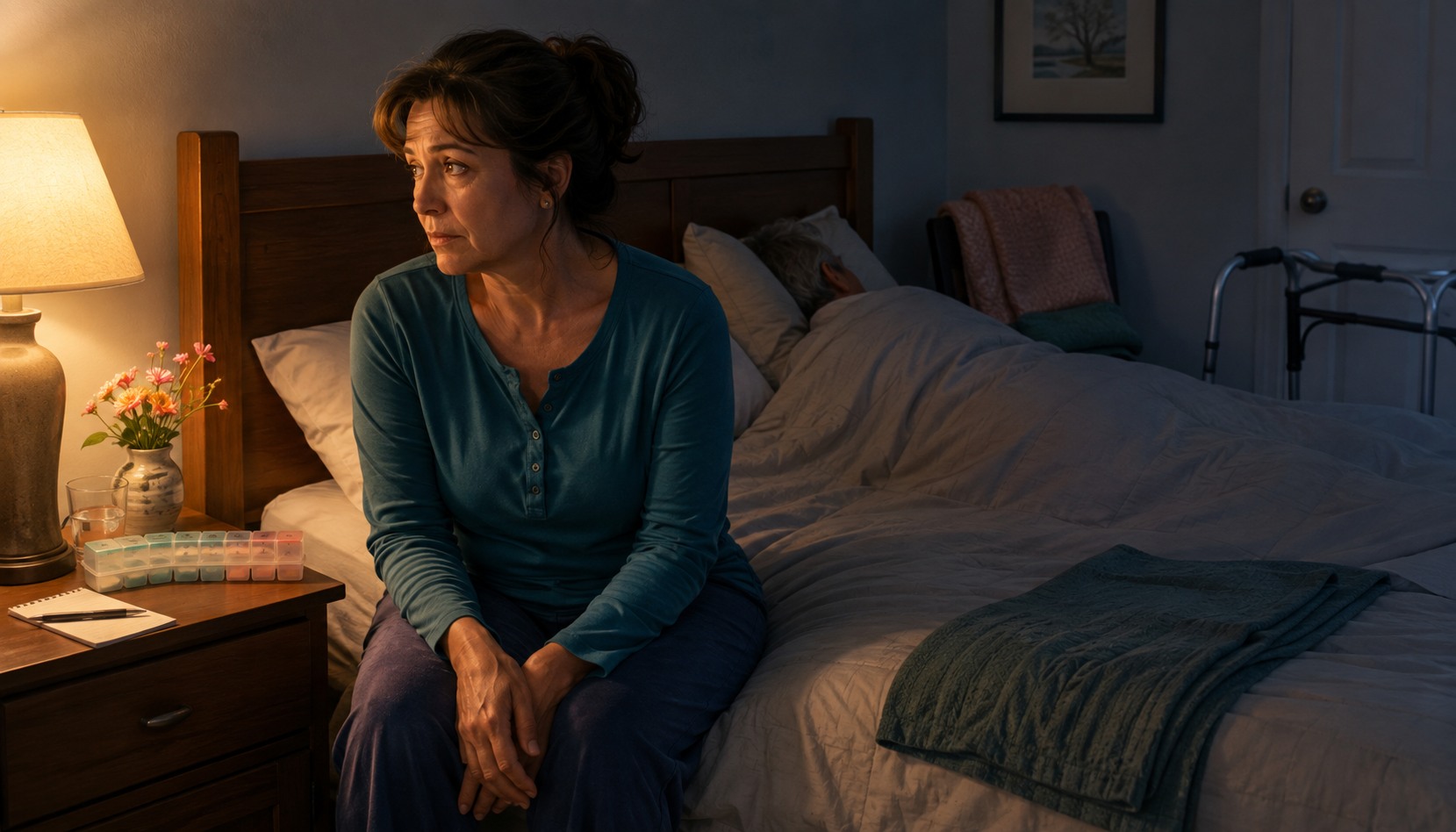
There is something uniquely rude about 3 a.m.
During the day, you can usually convince yourself you are handling things. There is light. There is coffee. There are tasks. There are people awake somewhere in the world.
But at night, everything gets louder.
The worry.
The exhaustion.
The pain.
The tiny noises.
The questions you cannot answer.
The feeling that you are the only person on earth still awake and responsible for keeping everything from falling apart.
Night does that.
It takes the same caregiving problems you were dealing with at 2 p.m. and turns the volume all the way up like a jerk with access to the remote.
You are not weak because things feel worse at night.
You are tired.
You are overstimulated.
You are probably underfed, dehydrated, interrupted, touched-out, worried, and running on a sleep schedule that would make a raccoon file a complaint.
And when your body is exhausted, your brain starts acting like every problem is urgent, permanent, and somehow your fault.
That does not mean you are doing caregiving wrong.
It means you are doing caregiving at night.
1. Night Takes Away the Backup Noise
During the day, even if caregiving is hard, there is usually some background noise that makes life feel less lonely.
People are texting. Offices are open. Pharmacies are answering phones. Delivery trucks are moving. Neighbors are making noise. Somewhere, someone is awake and wearing pants with a zipper.
At night, all of that disappears.
The house gets quiet. The world gets quiet. And suddenly, every sound feels important.
Was that a cough?
Was that a fall?
Was that the dog?
Was that the refrigerator making its normal weird refrigerator noise, or has the house decided to develop a medical condition too?
When you are the caregiver, quiet does not always feel peaceful. Sometimes quiet feels like being on call in a haunted building.
That is part of why nights feel worse.
It is not just the caregiving task itself. It is the feeling that you are doing it while the rest of the world has clocked out.
2. Your Brain Is Tired, So Everything Feels Bigger
A tired brain is a dramatic little goblin.
It takes a normal problem and adds fog machines, thunder, and a soundtrack.
A medication question feels scarier.
A bathroom trip feels harder.
A restless hour feels endless.
A small noise feels suspicious.
A simple decision feels like you are being asked to solve a crime with no clues and one sock.
During the day, you might be able to think through the next step. At night, your brain may skip straight to panic, guilt, or worst-case scenarios.
That does not mean you are overreacting.
It means your brain is exhausted and trying to protect you with the only tools it has left: alarm bells, weird thoughts, and a total inability to remember where you put the water bottle.
This is why tiny systems matter at night.
Not fancy systems.
Not color-coded binders.
Tiny ones.
A basket nearby. A soft light. A snack. A place to write down the thing your brain keeps screaming about.
Anything that removes one decision from your tired little raccoon brain is worth keeping.
3. Night Makes You Feel Like You Should Be Doing More
There is a specific kind of guilt that shows up at night.
The house is quiet, so your brain starts making a list.
- You should fold the towels.
- You should answer that message.
- You should organize the meds.
- You should research that symptom.
- You should clean the kitchen.
- You should be more patient.
- You should be calmer.
- You should be better at this.
Rude.
At 3 a.m., your job is not to become a fully upgraded version of yourself.
Your job is to get through the night safely.
That is it.
If someone needs help, help them.
If medication is due, handle it.
If there is an immediate safety issue, deal with it.
Everything else can get in line and wait for daylight like a civilized problem.
The dishes do not become more morally important because it is dark outside.
The laundry is not judging you.
The towels have nowhere to be.
You are allowed to lower the bar at night. In fact, you probably need to.
Lowering the bar is not laziness.
It is survival math.
And no, we do not have to like math for that to be true.
4. The Middle of the Night Lies to You
At night, everything can feel more permanent than it really is.
A hard hour feels like your whole life.
A bad moment feels like proof that you cannot keep doing this.
A scary thought feels like a fact.
A frustrating caregiving task feels like a personal failure.
That is one of the meanest things about the middle of the night.
It lies.
It tells you this will always feel this bad.
It tells you everyone else is handling caregiving better.
It tells you that needing help means you are failing.
It tells you that if you were stronger, calmer, more organized, or more grateful, this would not feel so heavy.
Absolutely not.
The middle of the night is not a reliable narrator.
It is tired, dramatic, poorly lit, and probably dehydrated.
You can acknowledge the feeling without believing every word it says.
You can say:
This feels awful.
This feels scary.
This feels lonely.
This feels too big.
And also:
I do not have to solve my entire life before sunrise.
I only have to handle the next thing.
What Helps When Night Gets Loud
When caregiving feels worse at night, the answer is not usually a massive life overhaul.
Nobody needs you to become a wellness influencer at 3:12 a.m.
Start smaller.
Try asking yourself:
- What actually needs to happen right now?
- What can wait until daylight?
- Do I need water?
- Do I need food?
- Do I need to sit down for sixty seconds?
- Do I need to write this down so my brain stops chewing on it?
- Do I need to stop treating the laundry pile like an emergency?
Tiny questions can help pull you out of the spiral.
Not always all the way.
But enough to find the next step.
And sometimes the next step is the whole victory.
You Are Not Doing Caregiving Wrong
If caregiving feels worse at night, it does not mean you are weak.
It does not mean you are dramatic.
It does not mean you are bad at this.
It means you are human, tired, responsible, and probably doing an impossible amount of invisible work while the rest of the world is asleep.
That is not nothing.
So tonight, lower the bar.
Use the soft light.
Eat the snack.
Write down the worry.
Let the towels continue their mysterious chair-based lifestyle.
You do not have to be inspirational in the middle of the night.
You just have to make it to morning.
And if 3 a.m. starts whispering that you are failing, remember this:
3 a.m. is a lying little jerk.