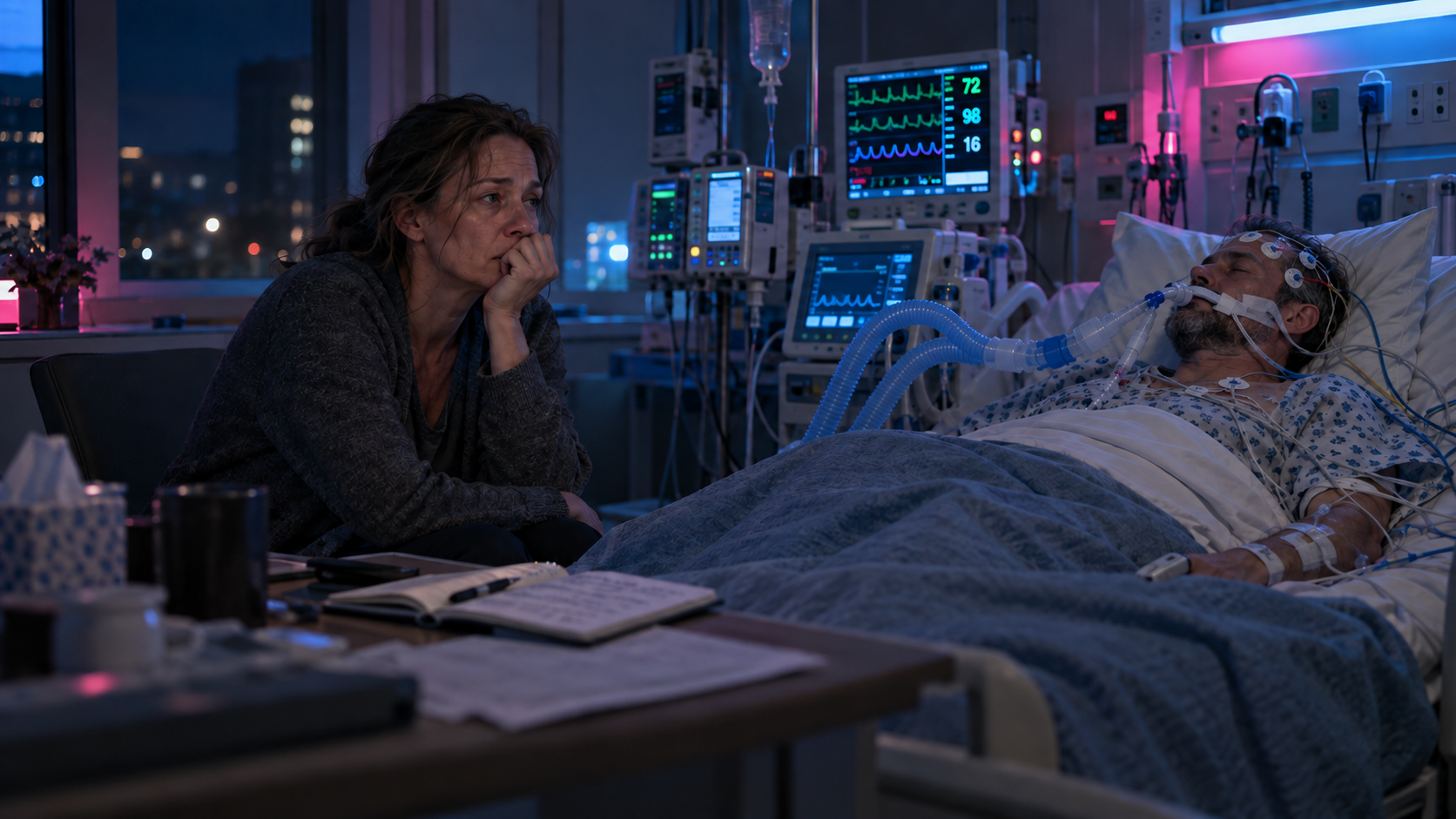
There was no meeting where somebody sat me down and explained that I was about to become a caregiver.
No orientation.
No handbook.
No nice little checklist.
Nobody walked up with a clipboard and said, "Okay, Sheila, here's what happens next."
One day, I was Sjohn's partner.
Then his heart stopped.
He had blood poisoning. He was gone for 34 minutes before they brought him back. He spent two weeks in a coma and woke up with an anoxic brain injury.
When he opened his eyes, he didn't know who I was.
That was the day our old life ended.
I just didn't know yet how much of it we had lost.
Nobody hands you the job description
In the beginning, you're not thinking about becoming somebody's caregiver.
You're thinking about survival.
That's it.
You sit there listening to doctors use words you've never heard before, and suddenly those words are supposed to matter more than almost anything else in your life.
You watch monitors.
You wait for test results.
You stare at numbers you don't understand.
You try to figure out whether the look on somebody's face means good news, bad news, or "we don't know yet."
And you learn very quickly that hope can hurt like hell when you're scared to trust it.
Then the decisions start.
Medications. Procedures. Insurance. Equipment. Rehab. Appointments. What happens next. What might happen next. What somebody thinks could happen six months from now.
People start asking you questions like you've had weeks to research all of this and calmly form an educated opinion.
Meanwhile, half the time you're still trying to understand what they just asked you.
Somewhere in the middle of all of that, without anybody officially announcing it, I became Sjohn's caregiver.
And apparently I also became his advocate, medical translator, appointment scheduler, record keeper, transportation department, insurance wrangler, medication tracker, and the person responsible for noticing every tiny change that might mean something was wrong.
Nobody asked if I wanted any of those jobs.
I didn't apply for them.
I loved him.
So I started doing them.
Those early months felt like trying to fly a spaceship after being handed the manual for a 1970 Volkswagen Bug.
I knew how to love him. I did not know how to operate the medical system, predict what he would need, or make decisions that suddenly carried so much weight. There was no time to learn one piece at a time. The spaceship was already in the air, alarms were going off, and everyone seemed to assume I knew where the controls were.
Coming home does not mean the emergency is over
People hear that someone is coming home from the hospital and think, "That's wonderful."
And yes. It is.
The person survived. They're coming home. That matters.
But people also tend to think coming home means the emergency part is over. Like you walk through the front door, put the hospital bags down, and everybody can finally relax.
That is not how it works.
A lot of the time, coming home is when the real work starts.
At the hospital, there are nurses. There are call buttons. There are machines and supplies and people who know what to do when something goes sideways.
At home? There's you.
You're the one watching for symptoms. You're the one wondering whether something is normal or whether you should be calling somebody. You're the one figuring out medications, bathroom trips, meals, mobility, equipment, appointments, paperwork, sleep, safety, transportation, and whatever fresh little disaster decided to show up that day.
Things that used to take five minutes suddenly require planning.
You learn very quickly that a building can technically be "accessible" and still be a complete nightmare when you're actually trying to get a disabled person through it.
You learn that a doctor's appointment at 2:00 does not mean your day starts at 1:30. It can mean your entire day revolves around getting one person dressed, ready, transferred, packed up, transported, unloaded, checked in, seen, loaded back up, brought home, settled again, and hopefully nobody forgot the paperwork.
Other people plan harder for a weekend getaway.
And leaving the room isn't always simple either. Sometimes leaving the house feels like a military operation run by one exhausted woman who is carrying twelve things, mentally tracking fifteen more, and cannot find her freaking keys.
The person you love is still here, but everything is different
There is grief in caregiving. That can make people uncomfortable because the person you love is still alive.
And of course you're grateful for that. I was grateful Sjohn survived. I still am.
But gratitude doesn't cancel grief.
You can be unbelievably grateful that someone lived and still grieve the life you had before everything changed. You can miss your old relationship. You can miss the plans you made. You can miss the freedom you had. You can miss the version of yourself who didn't spend most of the day thinking three steps ahead.
All of those things can exist at the same time.
You can be grateful and furious.
You can love somebody with everything you have and still feel trapped by what caregiving requires from you.
You can understand completely that they didn't choose what happened and still be angry that you didn't get a choice either.
That does not mean you love them less.
It means something terrible happened to both of you. One person became the patient. The other person's life changed too.
We just don't talk about that part nearly enough.
Caregiving can erase the caregiver
This part doesn't always happen all at once. Your life starts disappearing in little pieces.
You stop making plans because you have no idea what kind of day you're going to have. You stop saying yes to things because canceling for the fifth time starts feeling worse than not making the plan in the first place.
You lose sleep because you're listening. For movement. For coughing. For pain. For confusion. For somebody calling your name. For the sound that tells you something is wrong.
You put off your own appointments because getting yourself to the doctor feels like one more impossible thing to arrange.
You walk into the kitchen and forget why you're there because your brain is already keeping track of medications, appointments, bills, insurance calls, paperwork, symptoms, groceries, laundry, equipment, and whether you remembered to send that message you've been trying to send for three days.
People ask how the person you care for is doing. And they should.
But they don't always ask how you're doing.
After a while, you might stop asking yourself too.
You get really good at being useful. Sometimes so useful that everybody forgets there is still a whole human being underneath all of that usefulness.
Including you.
That is a huge reason I created CaregiverUnpaid. I wanted there to be a place that sees the caregiver too. Not as an assistant to the "real" patient. Not as the responsible family member standing in the background. Not as the person everybody assumes will just keep handling it.
As a person. A tired, overwhelmed, sometimes angry, sometimes funny, sometimes barely-holding-it-together person who deserves help too.
I wish someone had told me the truth
I wish somebody had told me love wasn't going to make caregiving easy.
Love matters. Of course it matters. But love does not magically give you energy, medical knowledge, patience, money, sleep, backup help, or an extra eight hours in the day.
I wish somebody had warned me that I could do everything right and still feel guilty. That I could make the best decision I knew how to make and still question myself at 2:00 in the morning. That exhaustion could make a perfectly capable person feel like they had no idea what they were doing. That paperwork could be the thing that finally broke me on a day when the actual medical crisis didn't. That asking for help and receiving useful help are two completely different things.
People love to say, "Just let me know if you need anything."
Caregivers know how complicated that sentence can become. Because now I have to figure out what I need, decide whether it's something you can realistically do, ask you for it, explain it, coordinate it, and possibly remind you.
Congratulations. Helping me has become another administrative task.
Most of all, I wish somebody had told me that struggling did not mean I was failing.
Caregivers are handed an absolutely ridiculous amount of responsibility with very little training, very little rest, and usually nowhere near enough support. Then somehow we're made to feel like we're doing something wrong when we can't carry all of it beautifully.
I am not interested in beautifully anymore. Or gracefully.
I am interested in honest. Useful. Practical. Good enough. Whatever gets us through today without pretending this is easier than it is.
If this happened to you too
Maybe you became a caregiver after a phone call. A diagnosis. A stroke. A fall. An accident. A hospital stay. Or one terrible day that divided your life into before and after.
Maybe nobody asked whether you were ready.
Maybe you didn't even realize you had become a caregiver until you were already buried in appointments, paperwork, medications, and responsibilities.
Maybe you're still waiting for the day when you finally feel like you know what you're doing.
I want you to know something.
You do not have to be endlessly patient. You do not have to be positive every minute. You do not have to pretend you don't miss your old life. And you do not have to have a color-coded binder and a cheerful attitude about any of this.
Caregiving is hard because it is hard. Not because you are doing it wrong.
You were handed a life-changing job with very little training, not enough rest, not enough help, and probably nowhere near enough warning.
That is exactly why CaregiverUnpaid exists.
For the person doing the caregiving. For the person searching Google at 3:00 in the morning because nobody explained what happens next. For the person buried in paperwork. For the person who loves somebody deeply and is still completely exhausted by what their life has become. For the person who is tired of being told to "take care of yourself" without anybody explaining when exactly you're supposed to squeeze that in.
You don't have to pretend here. You don't have to make caregiving inspirational. You don't have to call it a blessing. You don't have to be graceful.
You just have to get through the day you're in.
And if CaregiverUnpaid can make even one piece of that day easier, then that is exactly what I built it for.